
There are no items in your cart
Add More
Add More
| Item Details | Price | ||
|---|---|---|---|

A Complete Guide for Indian Students covering the best countries, top universities, popular courses, scholarships, application steps, and global career opportunities.
If you are an agriculture student wondering whether studying abroad can actually improve your career prospects, you are not alone.
For many students, agriculture begins with a simple goal: to find better ways to grow food, support farmers and build a more sustainable future. But, agriculture today is no longer limited to fields, tractors and traditional farming practices.
The agricultural sector is rapidly changing with the use of modern techniques and updated equipments such as drones, artificial intelligence, sensors, precision farming, biotechnology, data analytics, hydroponics, vertical farming and climate-smart agriculture.
Studying agriculture abroad can give students an opportunity to see these technologies in action, work with advanced research facilities and learn from agricultural systems that may differ significantly from those in India. But the main question revolving the whole topic is: “Is an international agriculture degree actually worth the investment?”
Well, the answer depends on your specialisation, selection of university, budget, career goals and the kind of experience you want to gain. This following guide covers everything you need to know about studying agriculture abroad: from the best countries and universities to popular courses, admission requirements, scholarships, application steps and career opportunities.
Since past some years, agriculture is becoming increasingly technology-driven and globally connected.
Countries around the world are taking their shot and investing in areas such as precision agriculture, sustainable farming, food security, agricultural biotechnology, climate-resilient crops and smart irrigation. So, for an Indian agriculture student, studying abroad can provide exposure to different approaches to these challenges.
| Key Advantage | Description & Impact |
|---|---|
| Advanced Facilities | Access to advanced laboratories and cutting-edge research facilities. |
| Modern Tech Exposure | Exposure to modern agricultural technologies (drones, satellite imagery, sensors). |
| Global Research | Opportunities to work on high-impact international research projects. |
| Practical Experience | Gain hands-on practical experience through fieldwork, internships and research. |
| Networking | Interaction with students and researchers from different countries. |
| Niche Specializations | Opportunities to specialize in emerging areas like climate-smart farming and circular food systems. |
| Policy & Systems | Exposure to global agricultural policies and diverse food systems. |
| Career Growth | Potential career opportunities in research, agribusiness, AgriTech and academics. |
For example, students interested in precision agriculture may explore technologies such as drones, satellite imagery, sensors and data-driven crop management. While those interested in sustainability may explore climate-smart farming, soil health, water management and circular food systems.
While looking for the best country to study agriculture abroad, one thing should be made clear in mind that there is no single "best country" for every agriculture student. The right destination always depends on what you want to study. A student interested in plant science may have different priorities from someone interested in agricultural economics, food technology or sustainable farming.
Some popular destinations to explore include USA, Netherlands, Canada, Sweden, Germany, Australia, Switzerland and UK. It is to be noted that, when shortlisting a country, comparing its universities, specializations, tuition fees, cost of living, scholarships, research opportunities and career prospects plays a vital role.
According to the QS World University Rankings by Subject 2026, Wageningen University & Research in the Netherlands ranks No. 1 globally for Agriculture & Forestry. The ranking includes 475 institutions. Swedish University of Agricultural Sciences ranks third, while China Agricultural University ranks fifth. However, rankings should not be the only factor you consider. A university that ranks highly overall may not necessarily be the best choice for your particular specialization, research interest or budget.
| Country | Universities to Explore | Subject Areas You Can Explore |
|---|---|---|
| USA | UC Davis, Cornell University, Purdue University, Iowa State University | Agronomy, Plant Science, Agricultural Development, Plant Pathology |
| Netherlands | Wageningen University & Research | Plant Sciences, Sustainable Agriculture, Environmental Sciences |
| Sweden | Swedish University of Agricultural Sciences | Agroecology, Sustainable Land Management, Forestry |
| Canada | University of Guelph, University of Alberta, University of British Columbia | Agronomy, Plant Science, Food Science, Agricultural Economics |
| Switzerland | ETH Zurich | Environmental Sciences, Food Systems, Agricultural Sciences |
| Belgium | Ghent University | Bioscience Engineering, Plant Production, Agricultural Sciences |
It is always advisable to check the university's current programme page before applying because course names, eligibility criteria and admission requirements can change.
Agriculture is a broad field, which means you don't have to restrict yourself to a general agriculture degree. Depending on your interests, you can specialize in various areas such as:
| Broad Category | Specific Specializations / Courses |
|---|---|
| 1. Agriculture & Plant Sciences | Agronomy • Plant Science • Plant Breeding & Genetics • Plant Pathology • Horticulture • Crop Science |
| 2. Environment & Sustainable Agriculture | Sustainable Agriculture • Agroecology • Climate-Smart Agriculture • Environmental Sciences • Soil Science • Sustainable Land Management |
| 3. Agricultural Technology & Innovation | Precision Agriculture • Agricultural Biotechnology • Agricultural Engineering • Digital Agriculture • Agricultural Data Science |
| 4. Food, Agribusiness & Related Fields | Food Science & Technology • Agricultural Economics • Agribusiness Management • Food Safety & Quality • Agricultural Economics & Policy |
If you have completed a BSc Agriculture or a related bachelor's degree, a master's programme abroad can help you gain advanced knowledge and specialize in a particular area. The application process varies between universities, but the following steps provide a useful roadmap as the starting point.
| Step | Action Phase | Detailed Description |
|---|---|---|
| Step 1 | Choose Your Specialization | Before searching for universities, put his question to yourself: “What do I actually want to study?” Think deeply considering everything whether you enjoy plant science or you are interested in agricultural technology, or you want to work on climate change or food security. Having clarity about your specialization first makes it much easier to shortlist universities. Popular options include Agronomy, Plant breeding and Genetics, Soil Science, Horticulture, Plant Pathology, Animal science, Food science, Agricultural Economics, Agricultural biotechnology and Sustainable agriculture. |
| Step 2 | Shortlist Countries and Universities | Once you know your preferred field, start comparing universities. Look at the Course curriculum, Faculty and research areas, Laboratory and research facilities, Tuition fees, Cost of living, Scholarships, Internship opportunities, Industry connections, Graduate career opportunities, Location and student life, University and subject rankings. Make the comparison wisely. Don't go for a university just because it appears high in a ranking. A slightly lower-ranked university with a strong research group in your chosen specialization may be a better fit. |
| Step 3 | Check Eligibility Requirements | Common eligibility norms are: A bachelor’s degree in agriculture or a related subject, Minimum marks or CGPA, Specific prerequisite subjects or credits, English-language proficiency, Academic transcripts, Letters of recommendation, Statement of Purpose, CV or resume, and GRE (where applicable). Some programmes may have additional requirements. Always proceed after checking the official programme page before preparing your application. |
| Step 4 | Prepare Your Documents | Start preparing your documents well before the application deadline. Common documents include: Academic transcripts, Degree certificate, Passport, Updated CV/resume, Statement of Purpose (SOP), Letters of Recommendation (LORs), English-language test score, GRE score (if required), Portfolio or additional academic documents (if required). Some programmes may also request research experience or publications. |
| Step 5 | Submit Your Application | Most universities allow students to apply online. Before submitting: Complete the application form carefully, upload the required documents, check the application fee (if applicable), review your information, and submit the application before the deadline. Keep a record of your application details and deadlines. |
| Step 6 | Apply for Scholarships | Don't wait until you receive an admission offer before researching scholarships. Some scholarships have separate application processes and earlier deadlines. Start searching for funding as soon as you begin shortlisting universities. |
| Step 7 | Receive Your Admission Offer | If your application is successful, the university may issue an offer letter. After accepting the offer and completing the required university formalities, you can begin preparing for the student visa and other pre-departure requirements. |
Students may need to demonstrate English proficiency depending on the university and programme. Commonly accepted tests include:
| Test Name | Evaluation & Acceptance |
|---|---|
| 1. IELTS | The International English Language Testing System (IELTS) evaluates: Listening, Reading, Writing, and Speaking. Many universities set minimum scores around 6.5 or 7.0, but requirements differ, so check your chosen programme. |
| 2. TOEFL | The Test of English as a Foreign Language (TOEFL) assesses: Reading, Listening, Speaking, and Writing. Required scores vary by university. |
| 3. PTE Academic | The Pearson Test of English Academic (PTE Academic) is a computer-based English-language test accepted by many institutions worldwide. |
| 4. Duolingo English Test | The Duolingo English Test (DET) is an online English proficiency test that can be taken remotely and is accepted by many universities. However, acceptance varies by programme. |
| 5. GRE | The Graduate Record Examination (GRE) may be required or recommended for certain graduate programmes, particularly at some universities in the USA. |
It is important to always verify the current requirements of the university you are applying to.
A PhD in Agriculture is different from a master's degree. For doctoral study, your research interests, academic background and potential research fit can be extremely important. At many universities, students may need to identify a potential supervisor or research group before or during the application process. However, this varies by institution and programme.
| Step | Action Phase | Detailed Description |
|---|---|---|
| Step 1 | Choose Your Research Area | Think carefully about the problem you want to investigate. Choose a research area that genuinely interests you because a PhD can take several years. Potential research areas include: Climate-Smart Agriculture, Precision Agriculture, Sustainable Farming, Plant Genetics, Crop Improvement, Soil Health, Food Security, Agricultural Biotechnology, Plant Pathology, Water Management. |
| Step 2 | Find a Potential Supervisor | Visit university websites and explore faculty profiles. Look for professors whose research interests overlap with yours. If the university permits or encourages prospective students to contact supervisors, your email should be concise and professional. It is advisable not to send the same generic email to every professor. A personalised message showing that you have read their research is more effective. You can include: A brief introduction, Your academic background, Your research interests, Why their research interests you, Your CV, and Research proposal (if required). |
| Step 3 | Prepare a Research Proposal | Some PhD programmes require a research proposal. A proposal may include: Research title, Background, Research problem, Objectives, Proposed methodology, Expected outcomes, References. Your proposal should clearly explain what you want to research, why it matters and how you plan to study it. |
| Step 4 | Prepare Your PhD Documents | Depending on the university, you may need: Master's degree, Academic transcripts, CV, Statement of Purpose, Research proposal, Recommendation letters, English-language test score, Research publications (if available). Requirements vary, so check the individual programme carefully. |
| Step 5 | Explore PhD Funding | One major advantage of research-based study is that funding may be available. Depending on the university and programme, funding can include: Tuition fee waivers, Stipends, Research assistantships, Teaching assistantships, Research grants, University-funded scholarships. Depending on the university's selection process, support may include tuition fee offsets, living stipends and certain allowances. |
| Step 6 | Prepare for the Interview | Some universities conduct interviews before offering PhD admission. You may be asked about: Your previous research, Your academic background, Your research interests, Why you chose the university, Why you chose the supervisor, Your proposed research, Your long-term career goals. Be prepared to explain your research idea in simple and clear language. |
| Step 7 | Complete the Visa Process | Once you receive your admission offer and complete the university's formalities, you can begin the student visa process. Visa requirements vary by country, so use the official immigration website of your destination country for current requirements. |
There is no universally "best" country for studying agriculture. Instead, the questions that need to be considered by a student are:
| Key Question | Considerations & Factors |
|---|---|
| 1. Is the country strong in your selected domain of specialisation? | A country known for agricultural research may still not offer the programme or research group you need. |
| 2. Does the university offer practical or research opportunities? | Look beyond classroom learning. Check laboratories, field stations, research centres, internships and industry collaborations. |
| 3. Can you afford it? | Calculate the total cost, not just tuition. Include: Tuition fees, Accommodation, Food, Transportation, Health insurance, Visa expenses, Study materials, and Personal expenses. |
| 4. What scholarships are available? | Compare university, government and external scholarships. |
| 5. What are the career opportunities? | Check whether graduates typically move into research, industry, academia, agribusiness or other sectors relevant to your goals. |
| 6. What is student life like? | Consider: Climate, Culture, Safety, Language, Accommodation, Transportation, Distance from the place of accomodation. |
Studying abroad can be expensive, but scholarships and funding opportunities can significantly reduce the financial burden. Some opportunities agriculture students can explore include:
| Scholarship Name | Description & Eligibility |
|---|---|
| 1. Erasmus Mundus Joint Masters | Erasmus Mundus Joint Masters are international master's programmes delivered by a consortium of higher-education institutions. Students from around the world can apply, and selected programmes offer full scholarships. These can contribute towards participation costs, travel, visa and living expenses. |
| 2. DAAD Scholarships | The German Academic Exchange Service (DAAD) offers a range of scholarships for international students and researchers. Eligibility, funding and application deadlines vary by programme. |
| 3. Australian Research Training Program | The Australian Government's Research Training Program supports eligible research master's and doctoral students through participating Australian universities. Funding can include tuition fee offsets, stipends and certain allowances. |
| 4. Netaji Subhas–ICAR International Fellowship | Indian agriculture students interested in doctoral research can also explore the Netaji Subhas–ICAR International Fellowship. ICAR states that the fellowship supports doctoral research in agriculture and allied sciences, including Indian fellows going abroad. Eligibility and priority research areas should be checked in the latest notification. |
| 5. Chevening Scholarship | Chevening is a major UK government scholarship, but students should not assume it is suitable immediately after graduation. The current eligibility requirements include at least 2,800 hours of work experience acquired after completing an undergraduate degree, along with other criteria. Therefore, it may be more relevant to agriculture graduates who already have the required professional experience. |
So, are there actually good career opportunities after completing an international agriculture degree? The answer is, quite a lot.
Agriculture has expanded into areas such as: Agricultural technology, Biotechnology, Food systems, Sustainability, Agribusiness, Research, Data-driven farming, International development, Food processing, and Environmental management.
| Career Path | Role Description & Scope |
|---|---|
| 1. Agricultural Research | If you enjoy experiments and solving agricultural problems, research can be a strong career path then you may work as a research assistant, research associate, laboratory researcher or an agricultural scientist. Your work could involve experiments, field studies, data analysis or testing new agricultural technologies. |
| 2. Seed, Fertilizer and Crop Protection Industries | Agriculture graduates can explore technical, research and product-related roles in companies working in seeds, fertilizers, crop protection, biofertilizers, plant growth regulators, and agricultural biotechnology. |
| 3. Agronomist | Agronomists work on improving crop production and farm management. Depending on the role, they may work on crop planning, soil management, nutrient management, irrigation, pest management and farm productivity. This can be a good option for students who enjoy combining scientific knowledge with practical agricultural problems. |
| 4. Food Processing and Quality Management | Agriculture doesn't end when a crop leaves the farm. Food must be processed, stored, packaged and tested before reaching consumers. This creates career opportunities in food processing, food safety, quality assurance, quality control and supply chain management. |
| 5. International Development Organizations | Agriculture graduates can also explore opportunities with organizations working on: food security, rural development, climate change, sustainable agriculture and agricultural research. Potential organisations and networks include FAO, CGIAR centres, IRRI, CIMMYT, ICRISAT and the World Bank, although specific job requirements vary considerably. |
| 6. Start Your Own Agri-Business | An international degree doesn't necessarily mean you have to stay abroad. Some graduates return to India and use their knowledge to develop: Organic farming ventures, Greenhouses, Hydroponic farms, Seed businesses, Food processing units, Agricultural consultancy services or AgriTech startups. The knowledge you gain abroad can potentially be adapted to Indian agricultural conditions. |
A PhD can be particularly valuable for students who want to build careers in advanced research, academia or specialized R&D.
| Career Path | Role Description & Scope |
|---|---|
| 1. Research Scientist | Research scientists may work on: Crop improvement, Plant genetics, Plant diseases, Climate-resilient agriculture, Soil health, Sustainable farming, Agricultural biotechnology. |
| 2. University Professor or Academic Researcher | If you enjoy teaching and research, academia can be another career path. Depending on the country and institution, academic roles may involve: Teaching, Research, publishing scientific papers, Guiding students, Managing research projects. |
| 3. Postdoctoral Research | After completing a PhD, researchers may pursue a postdoctoral fellowship to gain additional research experience and collaborate with established research groups. |
| 4. Research and Development | Agricultural companies invest in R&D to develop new products, technologies and farming solutions. PhD graduates may work on areas such as: Crop genetics, Agricultural biotechnology, Plant protection, Digital agriculture, Sustainable farming technologies. |
| 5. Agricultural Policy and Development | Agriculture researchers can also contribute to policy and development programmes involving: Food security, Rural development, Climate change, Sustainable agriculture, Agricultural economics. |
For the right student, yes, but an international degree is not automatically worth the cost simply because it is from another country. It can be particularly valuable if you:
| ☑ | Have a clear specialization in mind |
| ☑ | Choose a university with strong research in your field |
| ☑ | Take advantage of laboratories and practical opportunities |
| ☑ | Gain relevant internships or research experience |
| ☑ | Build an international professional network |
| ☑ | Secure a scholarship or funding |
| ☑ | Have a clear plan for using the degree after graduation |
The goal should not simply be to "study abroad." The goal should be to gain skills, experience and knowledge that improve your career prospects.
For an Indian agriculture student, international exposure can be especially useful when it helps you understand technologies and agricultural systems that could potentially be adapted to local challenges.
Agriculture is changing, and so are the careers available to agriculture graduates. From precision farming and agricultural biotechnology to climate-smart agriculture, food security and AgriTech, the field is opening up opportunities that go far beyond traditional farming.
Studying agriculture abroad can give you exposure to different agricultural systems, advanced research and international networks. But the destination, university and programme you choose matter just as much as the decision to study abroad itself.
Think carefully taking everything into consideration like your specialisation, budget, university, scholarship options and career goals before making a decision.
Stay updated with our most popular guides, exam strategies, and career insights.
ICAR AIEEA PG is a national-level NTA entrance exam for admission to Master’s programmes in Agriculture, Horticulture, Forestry, Veterinary, Agricultural Engineering and other allied sciences.
Read Full Article →
Agriculture has evolved well beyond conventional farming, becoming a dynamic sector shaped by technological advances and sustainable business models.
Read Full Article →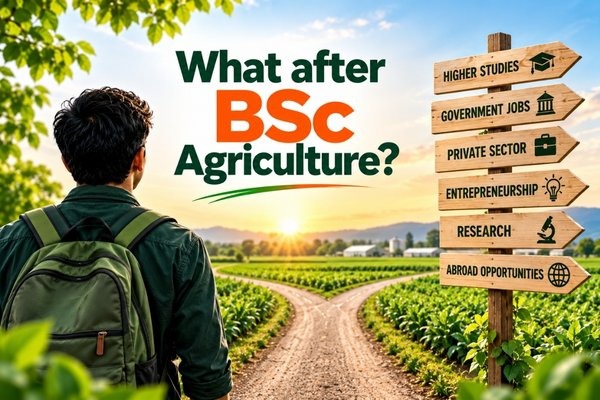
Every major opportunity after B.Sc. Agriculture — M.Sc. subjects and eligibility, top NIRF universities, entrance exams, government jobs, private roles and agri-startups.
Read Full Article → Launch your Graphy